Some links on this page are affiliate links. If you buy through one, we earn a small commission at no extra cost to you. As an Amazon Associate we earn from qualifying purchases. Full disclosure.
Buying a beekeeping starter kit is the easiest way to start, which is exactly why “kit” has become such a slippery word. Some kits hand you a complete hive with tools and a suit. Others give you a single box of wood and call it complete, leaving out things you assumed were included.
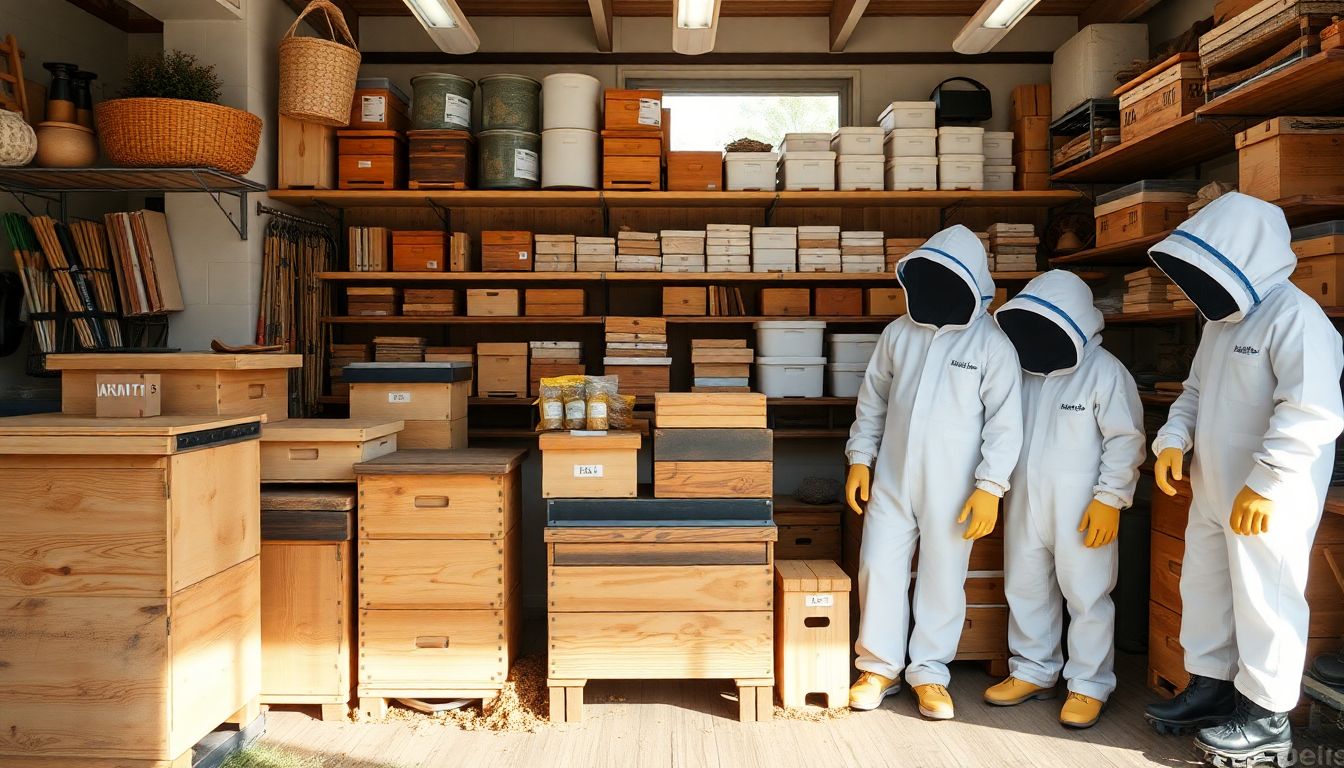
Plenty of beginners open their first delivery, boxes spread across the floor, only to realize they still need a smoker, a suit, and, oh right, actual bees. That gap between what you pay for and what shows up on the porch is where most beginners get frustrated. So this guide does two things the big 10-kit roundups skip. It tells you what a real kit should include, then names the few picks that make sense by situation, with the honest catch on each one.
If you are still deciding whether to keep bees at all, start with our beginner beekeeping orientation first. If you are ready to buy, keep reading.
What a good starter kit should include
A starter kit should get you a full home for a colony, not a partial one. The foundation of that is a complete Langstroth hive, which is the standard nearly every US club, supplier, and mentor builds around. Choosing Langstroth means every future frame, box, and piece of advice will fit what you already own.
At minimum, a complete hive means the box, frames, foundation, inner and telescoping covers, and a bottom board. Better kits add a jacket or full suit with veil, a stainless smoker, and a hive tool. A few details separate a good kit from a merely adequate one:
- A screened bottom board, which doubles as a varroa mite monitoring tool
- A beeswax-dipped or sealed exterior, since bare pine must be painted before it goes outside
- Assembled boxes rather than flat-pack, which spares a nervous beginner a pile of assembly errors
- Enough boxes for the standard first-year setup, which is two deep brood boxes plus one medium super
If you want to compare hive styles before you commit, our guide to the best bee hives breaks down Langstroth against top-bar and Warre. For most beginners, Langstroth is the answer.
What starter kits leave out (read this first)
Here is the part almost no roundup puts up front, so read it before you spend a dollar. Every kit leaves something out, and the gaps are predictable once you know to look.
No kit includes bees, ever. They are live animals you order seasonally as a package or a nuc, usually booking in December or January for spring delivery. Our guide to buying bees and nucs walks through sourcing them locally, since they do not ship in a cardboard hive box from Amazon.
A second brood box is often missing too. A healthy colony needs two deep boxes to overwinter, and plenty of “complete” kits ship with only one, so budget for an add-on.
The protective suit is the other frequent no-show. Mann Lake, Little Giant, Lyson, and MayBee all sell you the hive without it, so price a beekeeping suit or jacket into your plan. Every kit skips the honey extractor, and that one is fine, because you will not harvest or need one in your first year.
1. Best all-in-one: Mann Lake Complete Hive Kit Combo
If you want one purchase that gets the hive right, this is it. The Mann Lake Complete Hive Kit Combo runs about $238.95 and ships assembled, so there is no flat-pack puzzle waiting for you.
You get a 10-frame Langstroth setup with a deep brood box and a medium super, built from USA pine and finished in a low-VOC white paint. Assembled matters more than it sounds. A beginner who skips glue joints or misaligns frames pays for it later, and this kit removes that risk entirely.
The honest catch is what it does not carry. There is no suit, no smoker, and no hive tool, so plan on adding a tools bundle. The pine also needs resealing every three to five years to hold up outdoors, which is routine upkeep. For a beginner who wants the hive itself handled correctly and is happy to buy tools separately, this is the cleanest single choice.
2. Best budget setup: Little Giant hive + a separate tools kit
You can build a genuinely complete setup for under $200, and this is how. Pair a hive with a tools kit instead of hunting for one box that does everything, because that single box rarely exists at this price.
Start with the Little Giant 10-Frame Complete Hive at $124.99. It is the cheapest complete hive I trust for a beginner: telescoping and inner covers, a 10-frame body, frames with black foundation, USA-made interlocking joints, and a screened bottom board that also lets you monitor for mites. Then add the Honey Lake 31Pcs Beekeeping Supplies Kit at $67.99, which brings the full suit with hood, gloves, a stainless smoker, a hive tool, a frame grip, a bee brush, a honey gate, and a queen cage.
That combination lands at $192.98 for a real, wear-it-and-work-it setup. It is the decisive budget answer, and it beats most “all-in-one” kits at the same price because you are not paying for a compromise on either half.
3. Best for cold climates: an insulated polystyrene kit
If you keep bees where winter bites, insulation earns its keep. The Complete Lyson Beehive Kit runs about $199.95 and ships assembled, built from high-density polystyrene with 10 wooden frames and plastic foundation.
Poly holds heat far better than wood, so your colony spends less energy staying warm and you can often skip the winter wrapping that wooden hives need. It is also lighter to lift and fully Langstroth-compatible, so your frames and future boxes still fit. Two honest caveats keep it from being a universal pick.
Polystyrene cracks if you pry at it aggressively, so it rewards a gentle hive-tool technique rather than brute force. The white foam look can also raise eyebrows in a strict HOA, so glance at your rules first. In a cold region, those tradeoffs are easy to accept for the winter survival edge.
4. Best for easy harvesting: a flow-frame kit (with a caveat)
Flow-frame hives promise honey on tap, and they mostly deliver on that one promise. You turn a key, the comb cells split inside the frame, and honey runs out a tube into your jar with no extractor and no uncapping. The cedar Flow Bee Hive Starter Kit sits at the top around $339.99, while the budget XHDZSM Automatic Flow Hive Kit comes in near $179.99.
Here is the caveat that matters, because the marketing hides it. A flow hive automates extraction and nothing else. Inspections, varroa monitoring, feeding, and swarm control are exactly the same as on any other hive, so this is a convenience at harvest, not a shortcut to easy beekeeping.
The cedar Flow is beautifully built with observation windows, while the fir-bodied XHDZSM is the cheapest way to try the concept, though fir resists moisture less well than cedar. Buy it if you love the tap-to-harvest idea. Just do not expect it to skip the work, because it will not.
Kit versus buying the pieces separately
The question every beginner asks is whether to buy a kit at all, and the math is usually simple. For a first hive, a kit wins. Suppliers bundle compatible parts at a lower total than piecing the same components together one at a time, and you avoid the classic beginner mistake of ordering boxes and frames that do not match.
Buying separately makes sense in a few real cases:
- You want a specific ventilated suit rather than whatever a bundle includes
- You prefer cedar over the pine most kits use, for looks or longevity
- You are adding a second colony and only need some parts, not another full hive
Our beekeeping equipment guide lists every piece with what to prioritize, and the suit roundup helps if you want to choose your own protection instead of taking a bundle’s. For a true first setup, the kit almost always saves money and headaches.
The bottom line
For most beginners, buy a complete assembled Langstroth hive and add a suit separately, or take the under-$200 route. That means either the Mann Lake Complete Hive Kit Combo (about $238.95) plus a tools-and-suit bundle, or the Little Giant hive paired with the Honey Lake tools kit at $192.98 all in. Both get you a correct hive and real protection without a flat-pack gamble.
If your budget stretches, start with two hives rather than one. Extension programs recommend it so you can compare colony health and share frames from the strong hive if one weakens.
Expect roughly $400 to $700 in first-year equipment and another $150 to $250 for a package of bees, per Penn State Extension figures. A nuc runs a bit more, around $180 to $250, because it comes as an established mini-colony with a laying queen. Many states also charge $10 to $25 a year to register your hives, so check your local rules before spring. Our starter kit and cost breakdown has the full budget.
One last step no kit handles for you. Once the hive is on order, book your bees, because they sell out early and no equipment kit includes them.
Frequently asked questions
Are beekeeping starter kits worth it?
For a first hive, yes. A kit usually costs less than buying the same compatible parts one at a time, and it removes the guesswork of matching components. Just read the contents list closely before you buy, because many kits leave out the protective suit, a second brood box, and always the bees themselves.
What should a beekeeping starter kit include?
At minimum, a complete Langstroth hive: the box, frames, foundation, inner and telescoping covers, and a bottom board. Better kits also add a suit or jacket with a veil, a stainless smoker, and a hive tool. A screened bottom board is a bonus, since it doubles as a mite monitor. Bees are never included.
How much does a good beginner kit cost?
A complete hive kit runs roughly $125 to $240 in 2026. A full setup with tools and a suit lands around $190 to $300, and you can come in under $200 by pairing a budget hive like the Little Giant with a separate tools kit. Live bees are a separate $150 to $250.
Do starter kits come with bees?
No. Bees are live animals you order seasonally as a package or a nuc, usually booked in December or January for spring delivery. They are never part of an equipment kit and are sourced locally rather than shipped in a hive box, so plan that purchase on its own timeline.