# Inside a Beehive: Every Part and How It All Works
From the outside, a beehive is a stack of plain wooden boxes. It gives away almost nothing about what is happening inside, which is part of why people find them fascinating and beginners find them intimidating.
A hive is really two things stacked together. There is the box, which a person buys and assembles, and there is the nest, which the bees build inside it and organize entirely on their own terms. Most beginners get taught the first part thoroughly and the second part barely at all, which is why so many people can name every component of their hive and still stare at a frame with no idea what they are looking at.
This guide covers both.
The box: what a hive is made of
The manufactured part of a hive is simpler than the catalogs make it look. From the ground up, a typical hive has a stand to keep it off damp soil, a bottom board that forms the floor and provides the entrance, one or more boxes that hold frames, an inner cover, and an outer cover that sheds rain. Many beekeepers add a queen excluder between the brood boxes and the honey boxes above.
That is genuinely all of it. Everything else you see in a supplier catalog is an accessory rather than a part of the hive.
What matters is understanding what the box actually is: a weatherproof cavity with removable walls of comb inside. The wooden parts do almost nothing except keep weather out and hold the comb in a way that lets you take it apart. Our Langstroth hive guide covers the exact parts and dimensions, and our best beehives guide compares the different styles if you are choosing one.
Bee space: the measurement everything is built around
There is one number that makes the entire design work, and without it a hive would be a solid block of wax and resin that you could not open.
Bees leave a very specific gap alone. Give them a space of roughly 6 to 9 millimeters, about a quarter to three eighths of an inch, and they will neither build comb across it nor seal it shut with propolis. Make the gap smaller and they fill it with propolis. Make it larger and they build comb in it.
That measurement is called bee space, and every gap in a modern hive is sized to it. It is the reason frames hang separately instead of being fused to each other and to the walls, and therefore the reason you can lift one out, look at it, and put it back. Every inspection, every mite count, every time a beekeeper moves a frame of brood into a weak colony, all of it rests on that one gap.
What the bees build: comb
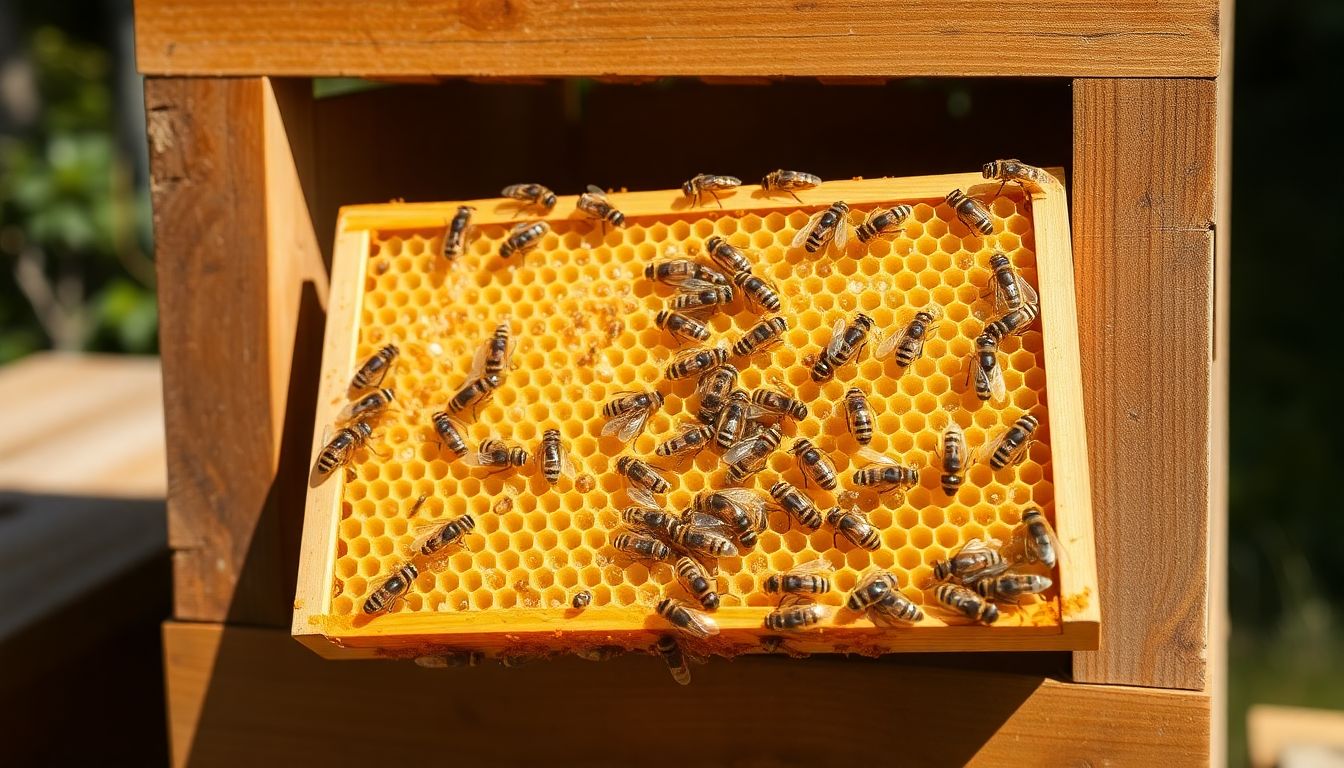
Inside that cavity, the bees build the thing that actually matters. Worker bees secrete beeswax from glands on their abdomens and work it into sheets of comb that hang vertically, with cells opening out from both faces.
The hexagon is not decorative. Cells are essentially cylinders, and cylinders packed so that each one touches six neighbors can share walls rather than each having its own. The result stores the most volume for the least wax, which matters enormously to an organism that has to eat a great deal of honey to produce a small amount of wax.
Comb is also doing three jobs at once, which is unusual. It is the nursery where brood is raised, the pantry where honey and pollen are stored, and the structural skeleton of the whole nest. Our best bee hive frames guide covers how foundation gives the bees a starting pattern to build on.
The three kinds of cell
Not all cells are the same, and learning to tell them apart is most of what frame reading involves.
| Cell type | Size | How to recognize it |
|---|---|---|
| Worker | About 5.2 to 5.4 mm on foundation, often 4.6 to 5.1 mm in natural comb | The default; flat tan cappings over brood |
| Drone | About 6.2 to 6.6 mm, roughly 17 percent larger | Noticeably bigger, with domed cappings that stand proud of the surface |
| Queen | Much larger, built as a separate structure | Peanut shaped and hanging downward, usually on the bottom edge or comb face |
Worker cells make up the bulk of any comb and get used for both brood and storage. Drone cells appear in patches and are entirely normal in moderation. Queen cells are the ones worth paying attention to, because a colony only builds them when it intends to swarm or is replacing its queen, and where they sit on the frame tells you which. Our swarm management guide covers reading that signal.
The brood rainbow: how a frame is organized
If you internalise one thing from this page, make it this one.
A colony does not scatter brood and food randomly across a frame. It arranges them in concentric layers. Brood sits in the center, where it is easiest to keep warm. Immediately around the brood is a ring of stored pollen, because pollen is the protein that nurse bees feed to larvae and they need it within reach of the work. Above and outside that sits an arc of capped honey.
Beekeepers call the layered result a brood rainbow, and it is diagnostic. A tight, well ordered rainbow with a solid block of brood in the middle means a laying queen and a functioning colony. Gaps in the brood, scattered empty cells, or a broodnest backfilled with nectar so the queen has nowhere to lay all mean something has gone wrong and is worth investigating. Our beehive inspection guide covers reading this in practice, frame by frame.
How the hive is organized vertically
Step back from the single frame and the same logic repeats through the whole stack.
The brood nest sits low, near the entrance and in the warmth the cluster generates. Honey accumulates above it and out toward the edges, because bees naturally store surplus above and around the nursery rather than below it. Supers added on top are simply extra storage space in the direction the colony already wanted to expand, which is why a queen excluder placed between the brood boxes and the supers keeps the queen out of the honey you intend to harvest.
The useful thing to notice is that the colony organizes itself this way whether or not a beekeeper is involved. Hive design follows bee behavior rather than the other way around.
The propolis envelope, and what manufactured hives lost
This is the part of hive structure that beginner guides almost never mention, and it is worth knowing.
When honey bees move into a hollow tree, one of the first things they do is coat the rough inner walls of the cavity with propolis, a resin they collect from tree buds. The result is a continuous lining that researchers call a propolis envelope, and it is a defensive structure rather than just glue.
Manufactured hives interrupted this by accident. Milled lumber is smooth, and bees given smooth walls largely do not build the envelope. In standardising hive boxes for our convenience, the industry quietly removed something the colony had evolved to build.
The research on what that costs is fairly consistent. Studies published in Scientific Reports, the Journal of Experimental Biology, and PLOS One link the presence of a propolis envelope to measurable immune benefits at both the individual bee and whole colony level, including improved resistance to Paenibacillus larvae, the bacterium that causes American foulbrood. Our bee health and pests guide covers why foulbrood is taken so seriously.
The practical takeaway is straightforward. Bees will build an envelope if you give them a surface worth coating, so rough textured or unfinished interior surfaces encourage it. Some suppliers now sell boxes with deliberately roughened interiors for exactly this reason, and scoring the inside of a plain box achieves something similar. It costs nothing and works with the colony’s own defences rather than against them.
The natural nest compared to the hive we build
It is tempting to conclude from all this that natural nests are simply better, and that is too neat.
There are real differences. Natural comb tends to run about 36 to 38 millimeters from center to center, while the Hoffman frames used in a Langstroth sit closer to 35. Standard foundation embosses worker cells at about 5.4 millimeters, while bees building freely often make them smaller. Wild colonies choose their own cavity size, shape, and entrance, and coat the whole thing in propolis.
What the managed hive buys in exchange is significant though. Standardized spacing is exactly what allows a beekeeper to lift out a frame, count mites, spot disease early, feed a struggling colony, or move brood between hives. A colony in a tree wall gets none of that help, and in an era where varroa kills untreated colonies, that help is often the difference between a colony living and dying.
The honest framing is that a managed hive is a deliberate compromise. It is worth knowing which parts of it are for the bees and which parts are for us.
Frequently asked questions
What is inside a beehive?
Frames of wax comb, and the colony living on them. The comb holds brood in the center, a ring of stored pollen around it, and capped honey above and outside, with brood low in the hive and honey stored above. Everything else, the boxes and covers, is just a weatherproof shell around that.
What are the parts of a beehive?
A stand, a bottom board that forms the floor and entrance, one or more boxes holding frames, an inner cover, and an outer cover. Many hives also use a queen excluder between the brood boxes and the honey supers. The frames inside the boxes are where the bees build comb.
Why are honeycomb cells hexagonal?
Because hexagons tile together without wasted gaps and let neighbouring cells share walls. Since bees must consume a large amount of honey to produce a small amount of wax, a shape that stores the most with the least material is a significant saving for the colony.
Your next step
If you are choosing a hive, our best beehives guide compares Langstroth, top-bar, Warre, and Flow hives side by side. For the exact parts, sizes, and what to buy, see the Langstroth hive guide. And when you know what you are putting where, our guide to keeping bee hives in your backyard covers siting, rules, and neighbors.
Sources and further reading
- PLOS One, Thinking inside the box: restoring the propolis envelope facilitates honey bee social immunity, on what changes when colonies are given surfaces they will coat.
- Scientific Reports, Propolis envelope in Apis mellifera colonies supports honey bees against the pathogen Paenibacillus larvae, on the foulbrood connection.
- BeeKeepClub, Understanding the honeybee brood nest, a practical walkthrough of how the brood nest is arranged.