Some links on this page are affiliate links. If you buy through one, we earn a small commission at no extra cost to you. As an Amazon Associate we earn from qualifying purchases. Full disclosure.
A swarm is not your colony failing. It is your colony succeeding so thoroughly that it decides to reproduce, which from the bees’ point of view is the whole objective. From yours it is expensive: you lose roughly half your workforce and, with them, most of the honey crop you were counting on that season.
The good news is that swarming is largely predictable, and the main trigger is one you control. This guide covers how to read the signs on a frame, the three prevention moves that actually work, what to do when a colony swarms anyway, and how to catch swarms yourself with a bait hive.
Why bees swarm
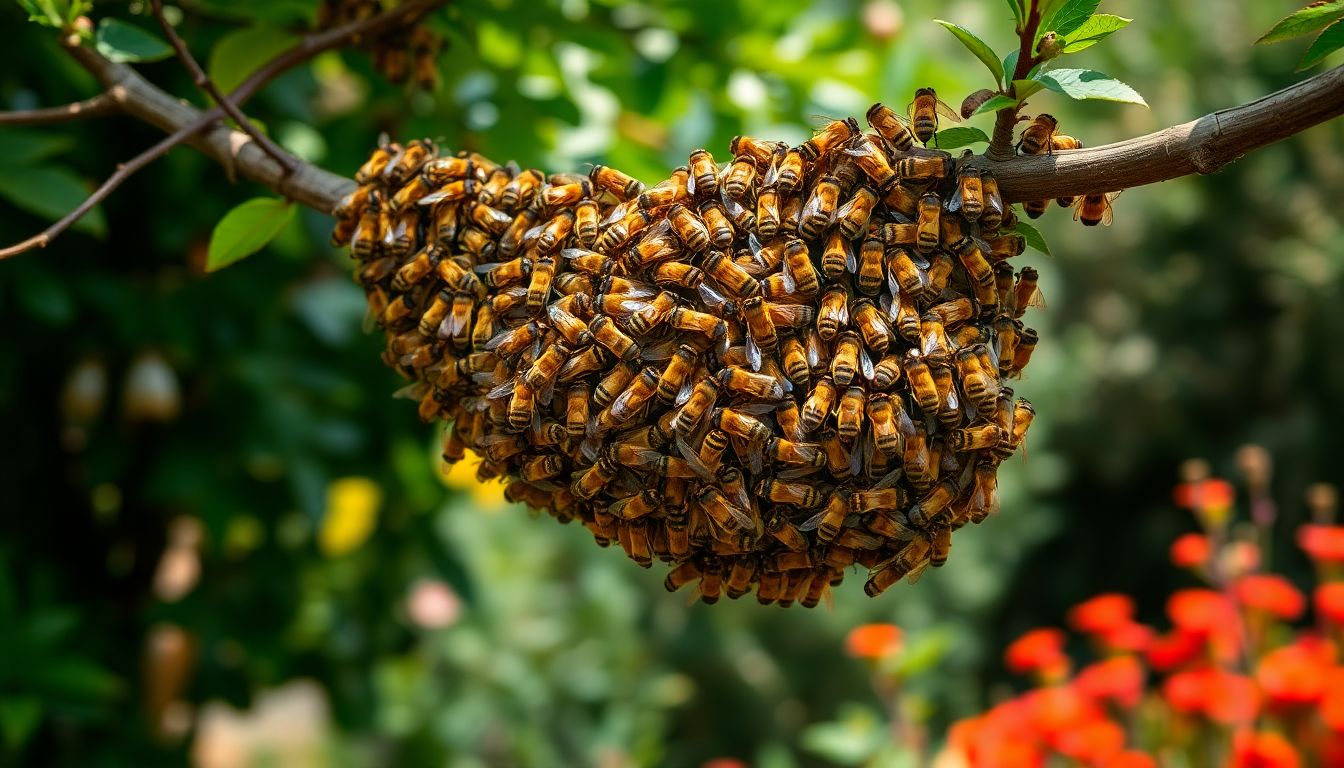
Swarming is reproduction at the colony level. A honey bee colony functions as a single organism, and the way it makes another one is to split in half. The old queen leaves with about half the workers to found a new home, and the original hive keeps the brood, the stores, and a set of queen cells from which the next queen will emerge.
Three things push a colony toward that decision. The main one is congestion: when there is nowhere left to lay eggs and nowhere to put incoming nectar, the colony reads itself as full. A strong spring buildup accelerates it, since the population can outgrow the boxes faster than beginners expect. And in a crowded hive, the queen’s pheromone no longer circulates well enough to reach every bee, which is part of what tells the colony it is time.
Congestion is the trigger you can do something about, and most of prevention comes down to that.
Swarm cells or supersedure cells?
Finding queen cells is alarming the first time, but where they sit on the frame tells you two completely different stories. This is the single most useful thing to learn about swarming.
| Swarm cells | Supersedure cells | |
|---|---|---|
| Location | Along the bottom edges of brood frames, hanging down | Centrally, on the face of the comb |
| Number | Many, commonly 7 to 20 or more | Usually only 1 or 2 |
| Timing | Spring, populous colony, full stores | Any time the queen is failing |
| Meaning | They intend to swarm | They are replacing an aging or injured queen |
Cells strung along the bottom bars in numbers are a swarm warning and call for action. One or two cells on the face of the comb mean the colony has decided its queen is not up to the job and is quietly raising a replacement, which is usually best left alone.
Timing matters enormously here. Once a swarm cell is fully capped, the colony is typically committed and the swarm may leave within days, so it is generally too late to prevent. The window for action is while the cells are still open. Our beehive inspection guide covers checking the bottom bars as part of a normal inspection, which is how you catch these in time.
The other warning signs
Queen cells are the clearest signal, but a colony usually tells you earlier.
Look for a broodnest backfilled with nectar, where cells that should hold eggs are full of stores and the queen has run out of laying room. Look for bees packed wall to wall with no empty comb anywhere. And in the days before a swarm the queen slims down, since the workers stop feeding her so heavily to get her light enough to fly, and her laying drops off.
One thing that is not a swarm signal: bearding. A curtain of bees hanging on the front of the hive on a hot evening is cooling behavior, and it worries new beekeepers far more than it should.
Prevention 1: give them space early
Space is the fundamental fix, and the rule is to add room before they need it rather than after they are already crowded.
That means putting on another box or super while there is still some empty comb, not waiting until every frame is full. A colony in a strong spring flow can fill a box startlingly fast, and beginners routinely get caught a week behind. Checking space is one of the three questions every inspection should answer, and our hive management guide sets the seasonal rhythm for when buildup is fastest in your area.
Prevention 2: make a split
If space alone is not enough, the most reliable option is to do the swarming yourself, on your terms. A split gives the colony what it wants, a division, while keeping all of the bees in your apiary.
The straightforward version: move the queen along with two to four frames of brood and a few shakes of bees into a nuc box. The original hive is left with the brood, stores, and queen cells to raise a new queen, and the swarm impulse is satisfied because the colony has effectively already divided.
You can do this from a few weeks before your local swarm season right through the moment you find swarm cells. Most experienced beekeepers treat splitting as the standard answer to swarm cells, since the alternative is watching half the colony fly away. Our guides to buying bees and nucs and the best beehives cover the equipment you will need for a second colony.
Prevention 3: checkerboarding
Checkerboarding is a more advanced technique that works on the colony’s priorities rather than its space. You alternate empty frames with drawn comb in and above the broodnest, so the colony reads its own stores as unfinished. A colony that thinks its survival is not yet secured will prioritize building and provisioning over reproducing, and it postpones swarm preparation.
It is done once a year, in late winter or early spring, before rapid buildup begins. The honest caveat is that it requires drawn comb you do not have in a first season, so treat this as a year-two tool rather than something to attempt with a brand new colony.
What not to do: cutting out queen cells
When beginners find swarm cells, the instinct is to scrape them off and consider the problem solved. That instinct is worth resisting.
Cutting out cells does nothing about congestion, which is the actual cause, so the colony simply builds new cells and you have bought a week at most. Worse, if the old queen has already left with the swarm, destroying the remaining cells removes the colony’s only route to a new queen and leaves it hopelessly queenless. Deal with the crowding or make a split. Removing cells on its own treats the symptom and creates a new problem.
If your bees swarm anyway
Every beekeeper loses a swarm eventually, and the situation is far less dire than it feels standing there watching them go.
What you have left is still a functioning colony: brood, stored food, and queen cells ready to produce a replacement. A virgin queen will emerge, take her mating flights, and begin laying. That whole sequence typically takes about three to four weeks, which feels like an eternity when you are opening the hive and finding no eggs.
The mistake to avoid is panic-requeening in week two. Give the colony the full window, then check for eggs. If there are still none by the end of it, the mating may have failed and a replacement queen is worth ordering, which our queen bees for sale guide covers. A reduced colony may also need help rebuilding, and our feeding bees guide covers when that is appropriate.
Catching swarms with a bait hive
Swarming works in both directions, and somebody else’s lost swarm can become your colony. A bait hive, or swarm trap, is an empty cavity set out to be found by scout bees, and it is the cheapest way there is to get bees.
The specifications matter more than people expect, because scouts are genuinely picky. Research on cavity preference is consistent:
- Volume: 40 to 60 liters, roughly 10 to 16 gallons. A standard deep Langstroth box is about 43 liters, which is why a spare deep works so well.
- Entrance: around two square inches, positioned low on one wall.
- Height: 12 to 15 feet off the ground is ideal. Lower traps do catch swarms, but scouts favor height because it means protection from predators and damp.
For bait, a single drop of pure lemongrass essential oil on a cotton ball or at the entrance does most of the work, because it closely mimics the Nasonov pheromone that scouts use to mark and call their swarm to a chosen home. Add one frame of old drawn comb, and rub the inside surfaces with propolis if you have it, since both signal an established, successful cavity. Refresh the lemongrass roughly every two weeks.
Timing is the last piece. Set the trap out two to four weeks before your local nectar flow peaks, which puts it in place before scouts begin house hunting. A ready-made swarm trap and a bottle of lemongrass swarm lure together cost a fraction of a package of bees.
If a swarm lands in your yard
If you are not a beekeeper and a football-sized cluster of bees has appeared on your fence post, the useful thing to know is that a swarm is usually about as harmless as bees get.
The bees gorged on honey before leaving and have no hive, no stores, and no brood to defend, which is most of what makes a colony defensive. They are resting while scouts look for a permanent home, and they typically move on within a day or two on their own.
Do not spray them, and there is no need for an exterminator. Nearly every local beekeeping association keeps a swarm list, and a beekeeper will usually come collect them at no charge, because a free swarm is genuinely valuable. Leave the cluster alone, keep pets and children back, and make the call.
Frequently asked questions
Why do bees swarm?
Swarming is how a colony reproduces. When a hive becomes crowded, with no room left for the queen to lay and nowhere to store nectar, it raises new queens and the old queen departs with about half the workers to start a new colony elsewhere. Congestion during a strong spring buildup is the usual trigger.
Are bee swarms dangerous?
Usually not. Swarming bees have filled up on honey and have no hive or brood to protect, so they are typically docile while clustered. Give them space, do not disturb or spray the cluster, and contact a local beekeeping club, which will normally collect the swarm for free.
Can you stop swarming completely?
No, and it is not a realistic goal, since swarming is a natural reproductive drive in a healthy colony. What you can do is reduce it substantially by adding space before the colony gets crowded, splitting strong colonies in spring, and inspecting often enough to find queen cells while they are still open.
Your next step
Catching swarm cells early is an inspection skill, and knowing when your local buildup accelerates is a calendar skill. Our beehive inspection guide covers reading the bottom bars and the broodnest, and our hive management guide sets the year-round rhythm so you are ahead of the spring rush rather than chasing it.