Some links on this page are affiliate links. If you buy through one, we earn a small commission at no extra cost to you. As an Amazon Associate we earn from qualifying purchases. Full disclosure.
For most people the hard question is not whether they want to keep bees. It is whether they can keep them here, in this particular yard, under whatever rules apply, with these particular neighbors on the other side of the fence.
That question has better answers than most beginners expect. Hives take up remarkably little room, most residential areas permit them with conditions, and the neighbor problems that do occur are largely preventable with two cheap fixes. This guide covers the rules to check, how much space you genuinely need, where to put the hive, and how to keep the people around you happy about it. If you are still deciding whether the hobby suits you at all, our beekeeping for beginners guide covers the time, the stings, and the honest downsides.
Is it legal to keep bees in your backyard?
Usually yes, with homework. Most residential areas allow hives subject to conditions rather than banning them outright, and urban beekeeping has become considerably more accepted over the past two decades.
The complication is that permission comes in layers, and clearing one does not clear the others. Check all four:
- Your city or county ordinance, which is where setbacks and hive limits usually live.
- Your HOA rules and CC&Rs, if you have an association.
- Your state agriculture department, which may require you to register hives.
- Any deed restrictions attached to the property itself.
A practical shortcut: your local beekeeping club almost certainly knows the local ordinance better than the city website explains it, and members have usually navigated the same HOA or permit process. Asking there will save you an afternoon of searching municipal code.
What ordinances typically require
Rules vary enormously between jurisdictions, so treat everything below as what is common rather than what applies to you. The actual figures for your address have to come from your own city and county.
| Provision | What is typical |
|---|---|
| Setback from property lines | Commonly 5 to 25 ft, with most ordinances landing around 20 to 25 ft |
| Flyway barrier | A solid fence or dense hedge at least 6 ft tall, often permitting a reduced setback in exchange |
| Hive limit | Typically 1 to 4 hives on an urban residential lot |
| Lot size | Sometimes a minimum such as 5,000 sq ft, or a restriction to single-family lots |
| Water source | Often required, maintained within a specified distance of the hives |
The pattern worth noticing is that ordinances are mostly trying to keep bees out of the airspace people walk through, and to stop bees looking for water in the wrong places. Both of those are solvable, and the sections below cover how.
Registering your hives
A number of states, and some cities, require you to register your hives. It is often free or costs very little, and it usually amounts to filling in a short form with your location and colony count.
It is worth understanding why the requirement exists rather than treating it as paperwork. Registration lets agricultural officials contact beekeepers in an area when a serious disease is found nearby, which matters because some brood diseases are reportable and spread between apiaries. It also feeds regional colony health tracking. If a foulbrood outbreak happens two streets away, being on that list is how you find out in time to act.
HOA rules are separate from city law
This trips up more people than the municipal code does. A homeowners association can be stricter than your city, and an HOA is entirely capable of prohibiting hives on a property where the city would happily permit them.
Read the CC&Rs before you buy equipment rather than after. If bees are not explicitly addressed, they may fall under a general nuisance or livestock clause, which is worth clarifying in writing rather than assuming. Some beekeepers have successfully brought an HOA around by submitting a short written plan covering the flyway barrier, the water station, hive numbers, and a commitment to requeen any colony that turns defensive. Showing that you have thought about the neighbors tends to land better than asking for permission in the abstract.
How much space you actually need
This is the part that surprises people, in a good way.
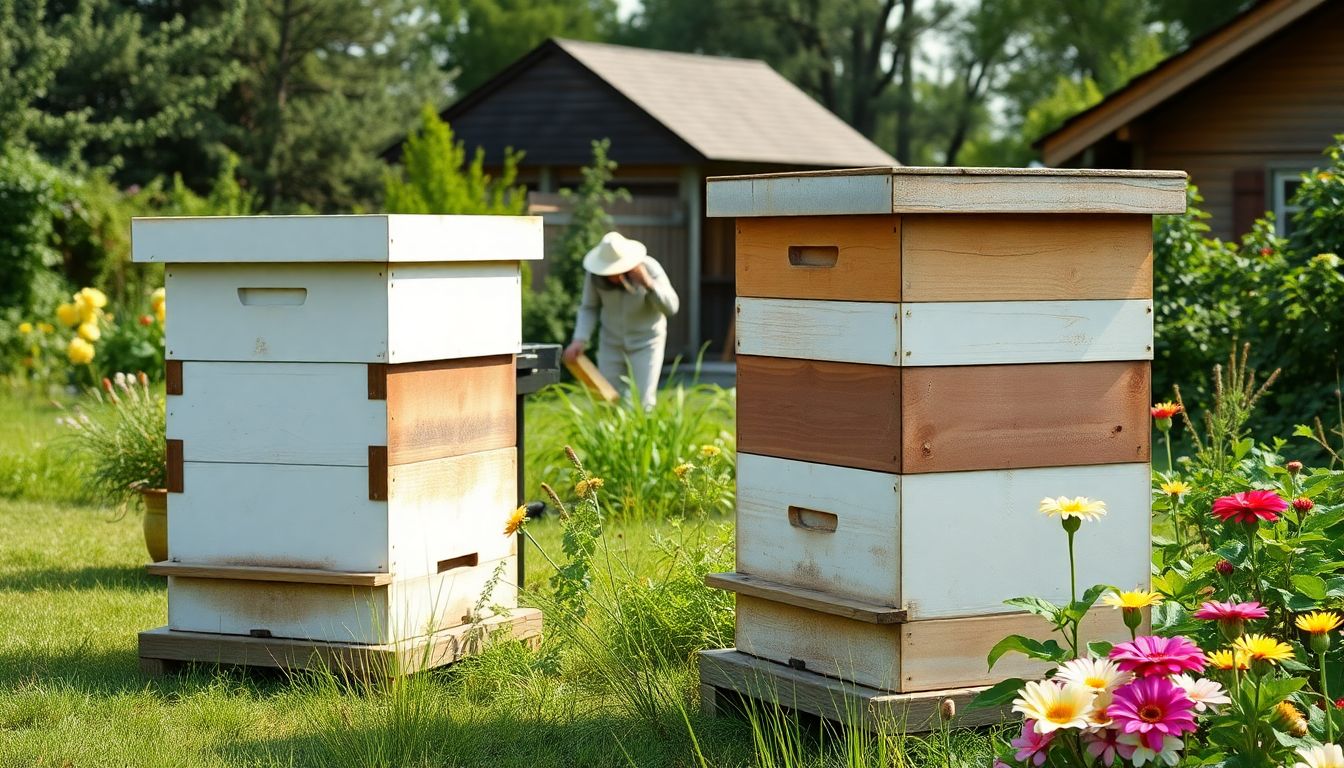
A single hive occupies roughly 2 to 2.5 square feet of ground, about 20 by 16 inches for a standard ten-frame box. What you need beyond that is working room, ideally around 5 feet of clear space on the sides and back so you can stand, open boxes, and set frames down without being wedged against a fence.
That means a backyard of 200 to 300 square feet can comfortably hold one or two hives with thoughtful placement. Most suburban yards have far more than that. A hive stand lifts the boxes off damp ground and saves your back at the same time.
The honest takeaway is that space is rarely what stops backyard beekeeping. Rules and neighbors are.
Where to put the hive
Within whatever space you have, placement does a lot of work.
Point the entrance east or southeast where you can. Morning sun hitting the entrance gets bees flying earlier, which means more foraging hours. Aim that entrance away from playgrounds, patios, sidewalks, and any path people regularly walk, because the area directly in front of a hive is busy airspace.
Set the hive somewhere dry and slightly elevated, on a stand, with a very slight forward tilt so condensation runs out the entrance rather than dripping back onto the cluster. Our winter beekeeping guide explains why moisture matters more than cold. A windbreak behind the hive, whether a fence, hedge, or stack of hay bales, cuts the wind that otherwise strips heat from the colony all winter.
If you have not chosen a hive yet, our best beehives guide compares the styles and their footprints.
The flyway barrier trick
Of everything in this guide, this is the single technique that solves the most problems at once.
Bees leave the hive on a fairly flat trajectory and build up height gradually, which creates a visible band of flying bees in front of the entrance at roughly human height. That band is what makes neighbors nervous and what ordinances are usually written to address.
Put a solid barrier in the way, a fence panel or a dense hedge at least 6 feet tall, positioned near the hive entrance, and the bees are forced to climb steeply as they leave. Within a few feet of the hive their flight path is above head height, and it stays that way across the neighborhood. People stop walking through bee traffic, and the hive becomes far less noticeable.
Many ordinances explicitly reward this by allowing a reduced setback where a flyway barrier is installed, so it can also be what makes a smaller lot workable. For the cost of a fence panel it addresses the legal requirement and the neighbor relationship simultaneously.
Solve water before they solve it for you
Bees need water, a lot of it, particularly in hot weather when they use it to cool the hive. If you do not provide a source, they will find the nearest one, and in a suburb that is very often a neighbor’s swimming pool, ornamental fountain, or dog bowl.
This is the most common complaint in backyard beekeeping, and the frustrating part is that bees imprint on a water source and keep returning to it. Once several thousand bees have decided the pool next door is the local watering hole, moving them off it is genuinely difficult.
So set up water before the bees arrive, and put it closer to the hive than any neighboring water. A bee water station works, though a shallow dish or bucket does the job equally well. The one thing that matters is a landing surface: stones, corks, floating wood, or gravel breaking the surface, so bees can drink at the edge without drowning. Keep it topped up, since a source that dries out sends them looking elsewhere.
Keeping neighbors on your side
Tell your neighbors before you set the hive up, not after they notice it. Discovering bees next door on their own is what turns mild curiosity into an objection, whereas being told in advance usually gets a positive or at least neutral response. Most people are more interested than alarmed once someone explains it to them.
A few habits keep it that way. Share the honey, and beeswax candles or lip balm if you make them, because a neighbor who receives a jar every autumn becomes an ally. Mention what you have done about water and the flyway barrier, since it shows the situation is being managed.
Then the temperament question, which matters most. Honey bees are defensive rather than aggressive, meaning they respond to threats near the hive rather than seeking people out at a distance. A well-tempered colony is a genuinely quiet neighbor. But colonies vary, and a persistently defensive hive is a problem to fix rather than tolerate, because one hot colony can sour a neighborhood on beekeeping permanently and end yours with it. The fix is requeening with gentle stock, which our queen bees for sale guide covers.
The other flashpoint is a swarm settling in someone else’s tree. It looks alarming even though a clustered swarm is nearly harmless, so managing swarming keeps you out of that conversation entirely, as covered in our swarm management guide.
How many hives fit a backyard
Most experienced beekeepers tell beginners to start with two colonies, which gives you a healthy hive to compare against a struggling one and means a winter loss does not end your beekeeping. Usefully, urban ordinances that cap hive numbers still commonly allow at least two, so the standard advice and the standard rule tend to agree.
Check your local limit before you buy equipment rather than after, since discovering a one-hive cap when two full setups are already in the garage is an expensive way to learn. Our how to start beekeeping guide covers where hive numbers fit in the wider plan, and our beekeeping cost breakdown explains why a second hive costs less than twice as much.
Frequently asked questions
Can I have a beehive in my backyard?
Usually yes. Most residential areas permit hives subject to conditions rather than banning them, but you need to check four things independently: your city or county ordinance, your HOA rules, your state agriculture department’s registration requirements, and any deed restrictions. Your local beekeeping club is often the fastest way to find out what applies locally.
How far do beehives need to be from property lines?
Setbacks commonly run from 5 to 25 feet, with most ordinances landing around 20 to 25 feet. Many jurisdictions allow a reduced setback if you install a flyway barrier, meaning a solid fence or dense hedge at least 6 feet tall that pushes the bees’ flight path above head height. Check your own ordinance for the figure that applies.
How much space do you need for a beehive?
Less than most people assume. A hive takes up roughly 2 to 2.5 square feet of ground, about 20 by 16 inches for a ten-frame box, and you want around 5 feet of working room around it. A backyard of 200 to 300 square feet comfortably fits one or two hives, so space is rarely the limiting factor for suburban beekeeping.
Your next step
Once the rules are checked and you know where the hive is going, the rest is process. Our how to start beekeeping guide walks the full sequence from ordering bees to your first winter, and our hive management guide covers the year-round rhythm once the colony is in place.