Some links on this page are affiliate links. If you buy through one, we earn a small commission at no extra cost to you. As an Amazon Associate we earn from qualifying purchases. Full disclosure.
The expensive parts of beekeeping sit in the shed most of the year. The cheap parts live in your hand every time you open a hive.
A hive tool costs a few dollars and you will touch it more than anything else you own, so it is worth a moment’s thought rather than grabbing whichever one came in the box. This guide covers which hive tool to buy and why the types differ, which accessories genuinely earn their place, and which ones you can leave on the shelf for a couple of years. For the whole-kit view, our beekeeping equipment guide covers everything from the hive down.
The hive tool: three types compared
Bees seal their home together with propolis, a resin so effective that boxes and frames often have to be levered apart. The hive tool is what does that, and there are three common designs.
| Type | Shape and size | Best at | Weakness |
|---|---|---|---|
| Standard (American) | Flat bar, about 9 in by 1.75 in, sharp pry end and a bent hook end | Prying boxes apart, scraping propolis and burr comb | Awkward on frames; you end up digging the blade into the wood |
| J-hook | Flat bar with a J-shaped notch, usually longer at about 10.5 in | Levering frames up cleanly with little damage | Slightly less comfortable for heavy box prying |
| Frame lifter | Curved, fork-like end that slips under the top bar | Gentle, secure frame lifting | Specialised rather than general purpose |
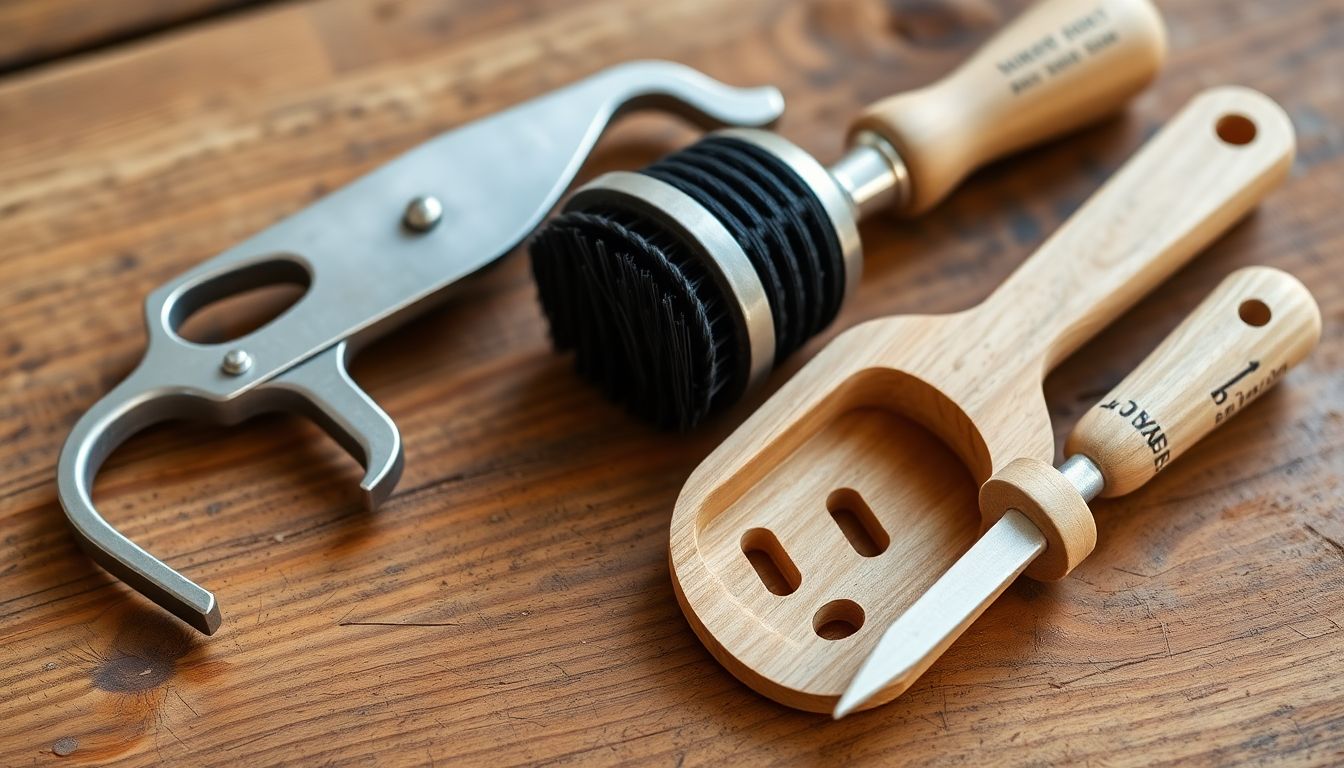
The standard tool is the one that ships in most starter kits, and it is genuinely versatile. It scrapes, it pries, it separates boxes that have been glued shut all season. Where it disappoints is the job you do most often, which is lifting frames. Without a hook, the usual technique is to wedge the blade under the frame ear and lever, and over a few seasons that chews up the woodwork.
The J-hook solves exactly that. The notch catches under the frame ear and lifts it straight up with far less force and far less damage to the frame and the bees on it. Most beekeepers who start with a standard tool end up buying a J-hook after a handful of inspections, and the common end state is owning both: the J-hook hive tool for frames and a standard hive tool for everything heavier.
A frame lifter is worth knowing about but is a specialist item. If you already have a J-hook, you have most of its benefit.
What to look for when buying one
Three things separate a tool that lasts from one that bends or rusts in a season.
Material comes first. Stainless steel outlasts chrome-plated versions, resists the rust that comes from scraping wet propolis and then leaving the tool in a damp shed, and takes prying pressure without deforming. High-carbon stainless is the pick, and a thickness of roughly 2.5 to 3 mm is the sweet spot: thin enough to slide into a tight seam, thick enough not to flex when you lean on it.
Then two pieces of practical advice that experienced beekeepers repeat constantly. Buy a brightly coloured one, because a bare steel tool set down in grass is effectively camouflaged and gone. And buy two. Hive tools disappear at a rate that surprises everyone, and being mid-inspection with a hive open and no tool is a genuinely annoying way to learn the lesson.
The bee brush
A bee brush is a long-handled brush with soft bristles that lets you sweep bees off a frame, off a box edge, or off your own sleeve without crushing them. It costs a few dollars and is helpful early on, when your handling is still tentative and you want a gentle way to clear bees before setting a frame down.
The caveat is one that gear lists tend to leave out: brushing an already agitated colony makes things worse. Bees dislike being swept, and a brush dragged through a defensive hive will escalate the mood quickly. Smoke and patience are the better tools when a colony is unsettled. A bee brush earns its place on calm days and at harvest time, when you need bees off frames you are about to carry away.
Frame grips and frame perches
A frame grip is a spring-loaded clamp that lets you lift a frame one-handed. The appeal is control: it holds the frame square, which reduces the chance of rolling bees against the neighbouring comb or rupturing fresh comb with your fingers.
Being honest about it, a grip is not automatically an upgrade. It has to be squeezed continuously while you hold the frame, and if your hand relaxes the frame drops, which is a bad outcome with the queen possibly on it. Plenty of experienced beekeepers use their fingers and never look back. A frame grip is most useful if you have weak grip strength or are handling heavy honey frames.
A frame perch is the simpler idea and the one more people should use. It hooks onto the side of the box and holds removed frames upright, off the ground and out from underfoot, which keeps them clean and stops you standing on comb. Our beehive inspection guide covers where a perch fits into the working order of an inspection.
Queen handling tools
This is the category beginners overlook and then wish they had not. A queen catcher, usually a hair-clip style cage, lets you trap the queen gently against the comb and hold her while you do something specific, most often marking her or moving her into a nuc during a split.
The value is not convenience so much as safety. Trying to pick up a queen with fingers you are not yet confident with is how queens get injured, and an injured queen is a much bigger problem than the job you were attempting. A queen catcher costs very little and removes that risk. Pair it with a marking pen, and our queen bees for sale guide covers the international colour code and why a marked queen saves you time at every inspection.
Entrance reducers and mouse guards
These two often get lumped together, and they do related but distinct jobs.
An entrance reducer narrows the hive opening so a smaller guard force can defend it. That matters most for a new colony, a weak one, or any hive you have just fed, since syrup advertises food and can draw robbers from every hive in the area. Our feeding bees guide covers the robbing risk in more detail.
A mouse guard is a metal strip with holes that lets bees through but not rodents. From fall onward, mice look for a dry cavity to spend winter in, and a beehive suits them perfectly. Once inside they chew comb and foul the hive, and a clustered winter colony cannot evict them. Fitting an entrance reducer or mouse guard before the cold arrives is covered in our winter beekeeping guide.
Smoker fuel and lighting kit
The smoker itself deserves its own consideration, and our best bee smokers guide covers sizes and build quality. What belongs in this list is the supporting kit.
Keep dry fuel where you can reach it: pine needles, burlap, untreated cardboard, or dried grass all work and cost nothing. Keep a reliable lighter or matches with your gear rather than in the house. A smoker that goes out with the hive half open is the classic beginner scramble, and it is almost always caused by damp fuel or nothing to relight with.
Small things that quietly help
None of these are exciting, and all of them reduce friction.
A bucket or plastic tub gives you somewhere to drop the scrap wax and propolis you scrape off, instead of flicking it into the grass where it attracts pests. A notebook or record book kept with your tools means you actually write down what you saw, which our beehive inspection guide argues is what turns a series of visits into real understanding. A spare pair of gloves in the kit saves an inspection when the first pair gets sticky, and our best beekeeping suits guide covers glove choices.
What you can skip for now
Plenty of tools in the catalogs are aimed at beekeepers with a harvest, which you will not have in year one.
Uncapping knives, cappings scratchers, uncapping tanks, and extractor accessories are all honey-harvest gear. A first-year colony is building comb and stores rather than producing a surplus, so buying that equipment now means it sits unused for a full season and possibly two. When a harvest does arrive, many local clubs lend or rent the expensive items, and our best honey extractors guide covers whether to buy or borrow.
A sensible starter set
Pulling it together, a first-year kit of hand tools comes down to a short list:
- A standard stainless hive tool, brightly coloured.
- A J-hook hive tool, either now or after your first few inspections.
- A bee brush.
- An entrance reducer, with a mouse guard before fall.
- A bucket for scrapings and a notebook for records.
Optional additions worth considering are a queen catcher, which is cheap insurance while you learn, and a frame grip if you want extra control lifting heavy frames.
The whole set costs a small fraction of the hive, which is why it is worth buying decent versions rather than the cheapest available. Many bundles include several of these already, and our best beginner starter kits guide covers which kits are genuinely good value.
Frequently asked questions
What tools do you need for beekeeping?
The genuine essentials are a hive tool, a smoker with fuel, and protective gear with a veil. A bee brush and an entrance reducer are inexpensive and useful early on. Everything else, especially anything related to harvesting honey, can wait until you have a colony producing a surplus.
What is the best hive tool for a beginner?
Start with a standard stainless steel hive tool, since it handles prying, scraping, and separating boxes that have been glued shut. Once you have done a few inspections you will likely want a J-hook as well, because the notch lifts frames far more easily and with less damage to the frame ears than levering with a flat blade.
Do I really need a bee brush?
Not strictly. A brush is cheap and handy for clearing bees off frames on calm days and during harvest, but it is the wrong tool for an agitated colony, where brushing tends to make bees more defensive. Smoke and slow movements do more to settle a hive than a brush ever will.
Your next step
If you are still assembling your kit, a bundle is usually the cheaper route, and our best beginner starter kits guide compares what each one includes. For the full picture of everything a first hive needs, from boxes to protective gear, start with our beekeeping equipment guide.