Some links on this page are affiliate links. If you buy through one, we earn a small commission at no extra cost to you. As an Amazon Associate we earn from qualifying purchases. Full disclosure.
# Langstroth Hive Guide: Parts, Dimensions, and Setup (2026)
Ask a local beekeeping club what hive a beginner should buy and you will almost always get the same answer. The Langstroth is the hive that the classes teach, the suppliers stock, and the mentor down the road already knows how to open.
This guide covers what you are actually getting: the parts and what each one does, the box sizes and what they weigh, the exact dimensions, and how to decide what to buy. If you have not settled on a hive style yet, our best beehives guide compares the Langstroth against top-bar, Warre, and Flow hives first.
Why the Langstroth became the standard
The whole design rests on one measurement.
In the 1850s, Lorenzo Langstroth worked out that bees leave a very specific gap alone. Give them a space of roughly a quarter inch to three eighths of an inch and they will neither build burr comb across it nor seal it up with propolis. Any smaller and they fill it with propolis, any larger and they build comb in it. That measurement became known as bee space, and Langstroth patented a hive built around it in 1852.
The consequence is the thing every modern inspection depends on. Because the frames hang with bee space around them, they lift out cleanly instead of being glued into a solid block that has to be cut apart. Removable frames are why you can check for eggs, count mites, or move a frame of brood into a split without destroying the colony’s work.
The practical payoff today is standardization. A medium box from one supplier fits a deep from another, frames interchange, and every video, book, and mentor assumes this hive. That compatibility is worth more to a beginner than any individual feature.
The parts, from bottom to top
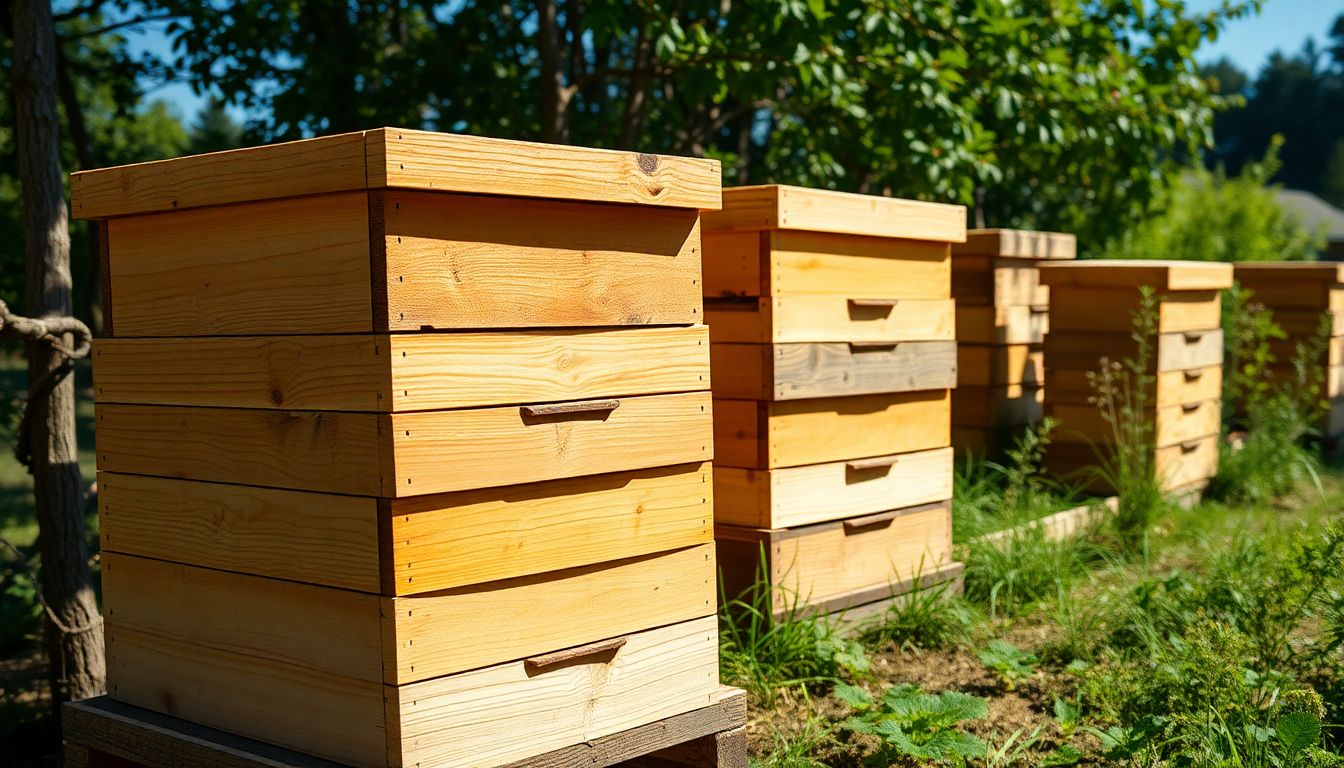
A Langstroth is a stack, and each layer has a job.
- Hive stand. Keeps the hive off damp ground, which slows rot and pests and saves your back.
- Bottom board. The floor of the hive. It extends forward into a landing board, and the gap at the front is the main entrance.
- Entrance reducer. A wooden strip that narrows that opening, so a small colony can defend itself and a wintering one loses less heat.
- Brood boxes. Usually two deeps, and where the colony actually lives. Bees tend to raise brood in the lower box and pack food into the upper one.
- Queen excluder. A mesh or slotted grid sized so workers pass through but the queen cannot. It sits between the brood boxes and the honey supers, keeping the queen from laying in the honey you intend to harvest. Brood in a super darkens the honey and makes extraction messier. A queen excluder is inexpensive, though some beekeepers prefer to run without one.
- Honey supers. The boxes above the excluder, where surplus honey accumulates and where your harvest comes from.
- Inner cover. Sits directly on the top box and handles insulation, ventilation, and moisture. The deeper ledge faces up.
- Telescoping outer cover. The roof, which fits down over the top of the hive like a hat and sheds rain past the edges.
Our beekeeping equipment guide covers how these fit alongside the rest of your kit.
Deep, medium, or shallow?
Boxes come in three depths, and the only meaningful difference for a hobbyist is how much they hold and how much they weigh full.
| Box | Depth | Typical use | Weight when full |
|---|---|---|---|
| Deep (hive body) | 9 5/8 in | Brood chamber and winter stores | Up to 80 lbs |
| Medium (super) | 6 5/8 in | Honey supers, or everything in an all-medium setup | About 50 lbs |
| Shallow | 5 11/16 in | Honey supers where weight matters | Lightest of the three |
That 80 pound figure deserves attention, because beginners consistently underestimate it. A full deep is an awkward, live, buzzing 80 pounds that you have to lift straight up and set down gently, often at arm’s length. A medium super holds roughly 35 pounds of honey and is far more manageable. If you have any doubt about lifting, size your boxes accordingly before you buy rather than after. A set of medium super boxes is the common compromise.
The all-medium setup
There is a straightforward answer to the weight problem that beginners rarely hear about early enough: skip deeps entirely and run mediums throughout.
In an all-medium hive, the colony lives in mediums and stores honey in mediums. Every frame fits every box, every box fits every hive, and nothing you lift weighs more than about 50 pounds. You stop keeping two sizes of frame in the shed and you stop discovering that the spare frames you grabbed are the wrong depth.
The tradeoff is simple arithmetic. Mediums hold less, so you need roughly three of them where two deeps would do, which costs a little more in boxes and frames. Plenty of experienced beekeepers consider that a bargain for never lifting a full deep again. Our best bee hive frames guide covers matching frame sizes to your boxes.
Eight-frame or ten-frame?
The other weight decision is box width.
Ten-frame boxes are the traditional standard. They hold more comb and more stores per box, and every supplier stocks them, so parts and secondhand equipment are easiest to find. They are also the heavier option.
Eight-frame boxes are the same length but narrower, holding eight frames instead of ten. The reduction in width takes a meaningful bite out of the weight, which is why they are popular with beekeepers managing back trouble or limited grip strength. Availability is good now, though slightly narrower than for ten-frame gear.
For most hobbyists the consensus leans toward weight mattering more than capacity. You will lift these boxes dozens of times a season, and a colony does not care whether its home is eight or ten frames wide. An 8-frame Langstroth hive is a reasonable default if you are unsure.
Langstroth hive dimensions
Standard dimensions are the reason parts interchange, so they are worth knowing before you buy or build.
| Measurement | 10-frame | 8-frame |
|---|---|---|
| External length | About 19 7/8 in | About 19 7/8 in |
| External width | About 16 in | About 14 in |
| Internal dimensions | 18 3/8 by 14 3/4 in | Same length, narrower |
Box depths are the same in both widths: 9 5/8 inches for a deep, 6 5/8 inches for a medium, and 5 11/16 inches for a shallow.
External measurements vary a little between suppliers depending on timber thickness and joinery, so if you are building your own boxes, match the internal dimensions and the bee space rather than copying an external figure. Our guide to building a beehive covers wood choice, joinery, and whether making your own actually saves money.
Setting one up
Most hives arrive flat packed, and both boxes and frames usually need assembling. Glue the joints as well as nailing them, since a hive that spends years outdoors in the weather works loose otherwise.
Paint only the exterior wooden surfaces. Never paint the inner cover or any interior surface, because the bees coat the inside themselves with propolis and wax, and paint or finish inside the hive is unnecessary at best. Two coats of exterior latex on the outside is the usual approach, left to cure fully before bees arrive.
Set the hive on a level stand with a very slight forward tilt. That tilt means any condensation that forms inside runs down and out the entrance rather than dripping back onto the cluster, which our winter beekeeping guide explains is a bigger threat than cold itself. Our how to start beekeeping guide covers choosing the location.
How many boxes a colony needs
A typical Langstroth colony lives in two deeps. The lower box holds the broodnest and the upper holds the food that carries them through winter. Supers go on above that as a nectar flow arrives, and come off at harvest.
Running all mediums, roughly three boxes replaces those two deeps, with supers added above as needed.
The rule that matters more than the count is timing: add the next box before the colony needs it, not after they have filled everything. A crowded colony starts thinking about swarming, and our beehive inspection guide covers checking for space as part of every visit. When the supers do fill, our best honey extractors guide covers getting the honey out.
Buying a Langstroth: kit or pieces?
Two routes, and the better one depends on how much you already know about what you want.
A complete Langstroth hive kit bundles the boxes, frames, bottom board, inner cover, and outer cover in one purchase. It is usually cheaper than sourcing the same parts individually, it guarantees the pieces fit together, and some kits add a suit, smoker, and hive tool. For a first hive it is the simplest path, and our best beginner starter kits guide covers which bundles are worth the money.
Buying pieces separately makes sense if you have already decided on something other than the default. Most kits ship as ten-frame with deeps, so if you want eight-frame boxes or an all-medium setup, assembling your own order is how you get it without paying for gear you will not use.
One more choice worth making deliberately: assembled boxes cost more than flat-packed ones but save you an evening with wood glue and a hammer. If you are buying several hives, that time adds up quickly.
Frequently asked questions
What are the dimensions of a Langstroth hive?
A ten-frame box measures roughly 19 7/8 inches long by 16 inches wide externally, with internal dimensions of 18 3/8 by 14 3/4 inches. An eight-frame box is the same length but about 14 inches wide. Depths are standard across both: 9 5/8 inches for a deep, 6 5/8 for a medium, and 5 11/16 for a shallow.
How many boxes does a Langstroth hive need?
Most colonies live in two deep boxes, with honey supers added above during a nectar flow and removed at harvest. If you run an all-medium setup, about three medium boxes replace those two deeps. Add the next box before the colony fills the current one rather than after.
Is 8-frame or 10-frame better for beginners?
Eight-frame boxes are noticeably lighter and suit anyone concerned about lifting, which for most hobbyists matters more than capacity. Ten-frame boxes hold more and have the widest availability of parts and used equipment. Either works well, so choose based on how much weight you want to handle.
Your next step
If you are still weighing the Langstroth against other styles, our best beehives guide lays the options side by side. If you have decided and want to price a purchase, our best beginner starter kits guide compares bundles. And when the hive is on its stand, our how to start beekeeping guide covers everything that follows.